
U-C Books to Prisoners embraces the wonderful gifts and perspectives that disabled volunteers can bring, but the nature of our program cannot fully accommodate everyone's needs. To help you make the best choice about whether we are a good fit for your volunteer needs and how you might go about contributing to our cause, we have tried our best to fully describe accessibility challenges you may face in our space. If you have further questions, please contact us for more information.
Alternative Volunteer Opportunities
Our workroom is the main entry point for volunteers, but we recognize that it's not accessible for all. We also recognize that our organization has lots of needs that don't require someone to go through the workroom. If, after reading the below information, you don't think you can volunteer in our workroom, please consider reaching out for other opportunities. We have plenty of work for people looking to build resume skills in accounting, event organization, technology, data management, writing, fundraising, advertising, or administrative work, and probably plenty of others!
Getting Here & Getting Inside
B2P is located in the basement of the Independent Media Center (IMC) at 202 S. Broadway Ave. in Urbana. The building is across from the Urbana bus terminal, the Lincoln Square stops served by the Green, Red, Orange, Grey, Bronze, Gold, Ruby, and Silver lines. That is also the location of the Urbana public parking deck, which has the best striped handicap spaces in the area, conveniently located in the corner closest to the IMC. From there, cross the intersection of Broadway & Elm east and south toward the building with the stone columns. Below is a map of nearby handicap parking and the various entrances to the IMC building:
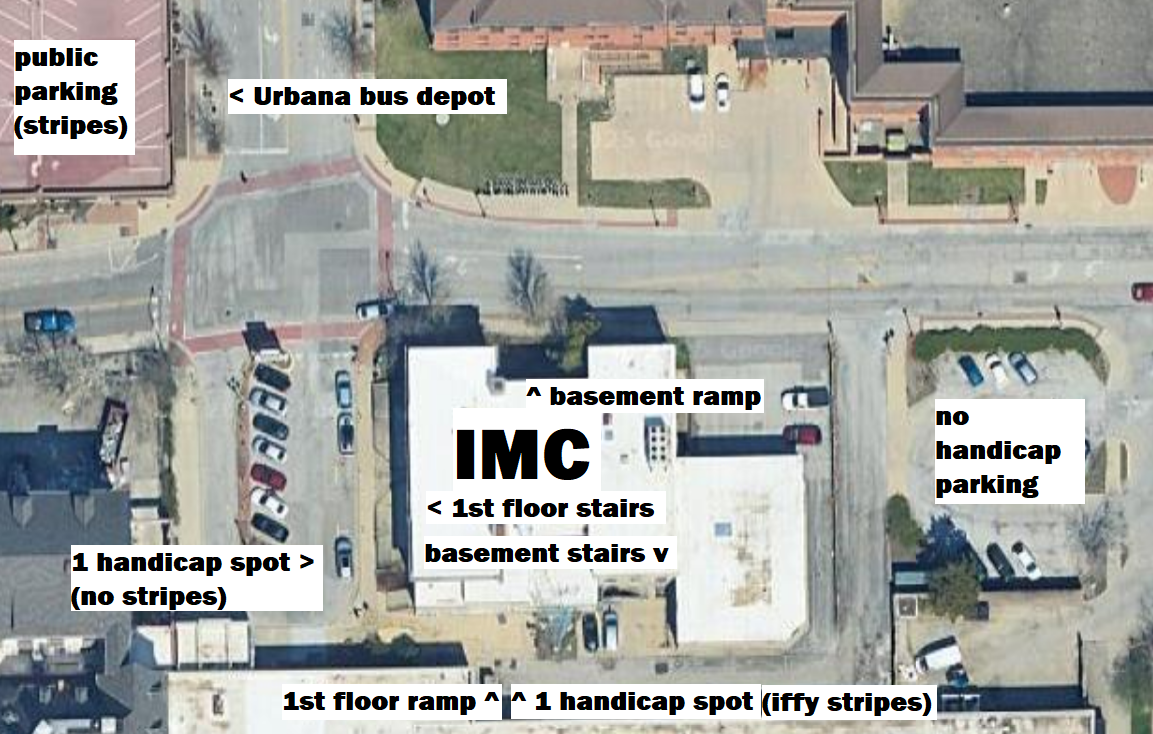
The IMC building is the historic Urbana post office. Like many old buildings, it poses some physical accessibility challenges. There is no elevator in the building, so do not use the first floor ramp to access the basement. An ADA-compliant basement ramp entrance is located on the north side of the building. Once inside, you will continue down the hallway until you see Books to Prisoners signage on your left. The basement stairs are located on the south side of the building in the alley. There is a sturdy railing on one side of the stairs, but they are concrete and somewhat steep. From this entrance, our workroom is straight ahead and on your right.
There is one handicap parking spot in the U-shaped driveway in front of the IMC, but it is a curb spot and does not have stripes. The passenger side of your car would unload onto a sidewalk and the driver side would unload into the driveway. This spot is about equal distances from the ramp and stairs.
There is a second handicap spot in the alley behind the IMC, accessible through the alley off Elm Street with the No Left Turn sign that says "Authorized Vehicles Only" (you are authorized vehicles). This spot is somewhat difficult to get in and out of, is occasionally blocked by other cars, and the stripes are on uneven ground that is difficult to traverse in a chair. It is also on the opposite side from the basement ramp.
Physical Access to our Workroom
For our primary volunteer route, filling book orders, being able to navigate and access our library is essential. Unfortunately, this crowded space is not accessible for wheelchairs, rollators, or walkers. We do have volunteers that use a cane, and crutches would also be fine. The small space does mean there are lots of surfaces to grab for stability. Someone who can walk and stand but needs to spend most of their time sitting could probably navigate the space with one of our rolling office chairs without too much trouble.
For those unable to access the workroom, you could be trained to clean book orders in the more accessible outer workspace, but we understand that scraping stickers off of books for two hours might not be everyone's idea of a good time. A wheelchair user able to stand long enough to put something on a shelf could also be trained to sort donations. That would be easiest for someone with enough arm strength to lift a box of books onto their lap.
Volunteer Commitment
If you have a disability that forces you to frequently cancel plans at the last minute, committing to volunteer work with B2P may be a challenge. Because our workroom is small, we have limited openings for volunteers, so someone who regularly takes a slot and then drops last minute reduces our volunteer capacity. For events like our book sale, last minute drop-outs mean we are understaffed.
Everyone gets sick or has emergencies sometimes, but if you know that your disability makes these frequent events, we ask that you wait until the day before or day of a volunteer session, when you are sure you can attend, to sign up. There are often openings on the day of from others who dropped out last-minute. For events, we ask that you not take a regular volunteer slot and instead let us know your situation and show up as extra help if you can make it.
Other Potential Challenges
Reading and writing. Volunteers need to be able to read standard-sized text, including handwriting, and write legibly in English with a pen. There is no time limit, so someone who reads or writes slowly will do just fine. Volunteers are welcome to bring assistive devices to help with reading and writing, such as magnifying glasses, extra lights, or special grips for pens. We don't have these stocked at B2P.
Talking and listening. We don't currently have any volunteers who can translate ASL, and trainings are given verbally in English. Being able to communicate verbally with volunteers and supervisors is necessary. We could of course accommodate a Deaf volunteer with a companion who can translate for them. A Deaf volunteer who reads lips could be successful so long as they ask for clarification when they need it.
Overhead lights. The lighting in our workroom has been a problem for individuals with photo-sensitive migraines in the past.
Small, crowded spaces. Volunteers should be comfortable in tight quarters or brushing past people while navigating a narrow aisle.
Big feelings. We serve populations that are enduring extreme trauma in our prison system, many of whom experienced trauma before incarceration as well. Sometimes they tell us about it. Many of our readers have been convicted of offenses that may challenge you, on a personal level. We do our best, as a group, to talk through the complicated emotions this work can stir up. Please be aware of your own personal sensitivities, your capacity to process this work, and any outside supports you may need after you leave the session.
Do you like this page?